If you’re navigating today’s housing market, you may be wondering what it really means to be in a buyer’s market. A buyer’s market happens when there are more homes for sale than there are active buyers, giving buyers more choices and less competition. With higher inventory levels, softer pricing, and fewer bidding wars, the balance of power shifts away from sellers.
This shift matters for both sides of the transaction. Buyers often gain negotiation leverage, from securing price reductions to asking for repairs or concessions, while sellers may need to adjust pricing and expectations to stay competitive. Whether you’re living in a home in Los Angeles or a condo in Miami, understanding how inventory, pricing trends, and negotiation dynamics affect your local market can shape your next move. In this Redfin real estate article, we teamed up with Michal Clements of Insight to Action to break down how a buyer’s market works and what it means for you.
What is a buyer’s market?
A buyer’s market exists when housing supply exceeds demand. In these conditions:
- Homes sell more slowly
- Price reductions become more common
- Buyers have stronger negotiating power
This is the opposite of a seller’s market, where demand exceeds supply and homes often sell quickly at or above asking price. A balanced market falls between the two, with relatively stable inventory and pricing.
| Buyer’s Market | Balanced Market | Seller’s Market | |
| Market Condition | Supply exceeds demand | Supply and demand are balanced | Demand exceeds supply |
| Pricing Pressure | Downward or stabilized; concessions common | Stable | Upward; limited concessions |
Because most people buy or sell infrequently, recognizing current market conditions is not always intuitive. The average homeowner keeps a property for roughly 12 years, meaning even repeat buyers may encounter very different dynamics than during their last transaction.
Signs you’re living in a buyer’s market
Several measurable indicators can help determine whether conditions favor buyers:
- Rising inventory
- Longer median days on market
- Increased price reductions
- Higher rates of seller concessions
- Growing months of supply
Two additional considerations are important: the difference between visible and less visible indicators, and variation across local markets.
Inventory levels
Inventory measures how many homes are actively for sale. Rising inventory often signals reduced competition among buyers.
FRED data (i.e., Federal Reserve Economic Data from the Federal Reserve Bank of St. Louis) show that housing inventory counts in the total US fell precipitously (more than 50%) post-COVID, bottoming out in 2022 (when compared to 2017). As can be seen in the chart below, housing inventories rose from these lows during 2024 and 2025. First quarter 2026 inventory levels are roughly flat with first quarter 2025 (9% higher).
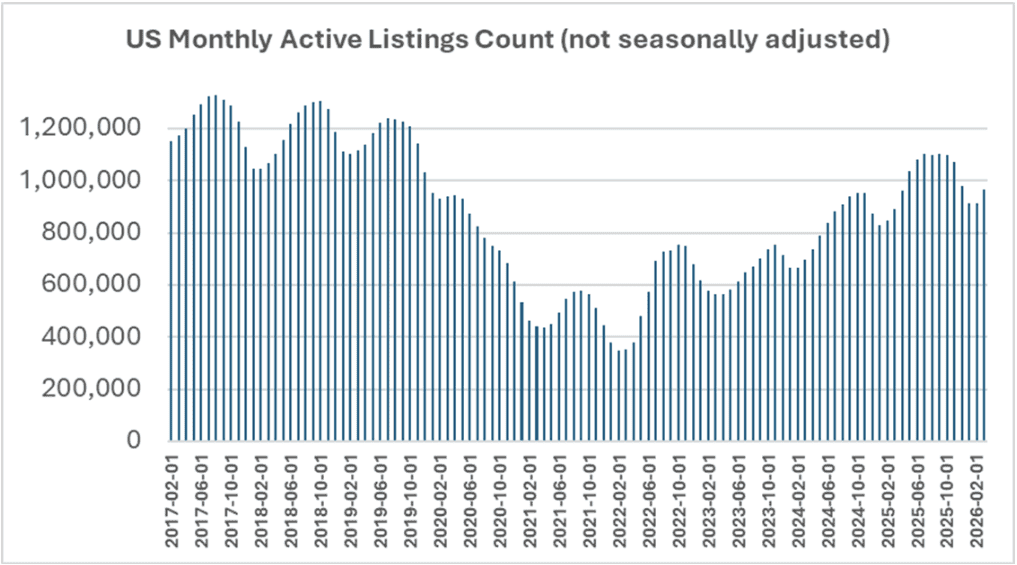
What this means is that first-time home buyers are facing a situation of increasing supply overall since 2023, while repeat or experienced home buyers face a situation where there is likely less total supply than when they last bought pre-COVID, even though supply did increase in 2024 and 2025.
“In Carson City, Nevada, we observed that newly built homes were priced similarly to established properties with comparable square footage and condition,” says Michal Clements. “With more new construction entering the market, buyers had increased choice and less urgency to act quickly.”
Median days on market
The median number of days a home stays on the market reflects how long homes take to sell. Nationally, this figure has risen in recent years, indicating a slower sales pace.
A related metric is the share of homes going under contract within one week. A decline in these “immediate sales” suggests fewer bidding wars and less pressure to make rapid decisions.
“When only a small percentage of listings are going under contract immediately, buyers can afford to be more selective,” Clements says. “That typically reflects softer demand relative to supply.”
Months of supply
Months of supply measures how long it would take to sell current inventory at the present sales pace.
General benchmarks:
- 6 or more months: Buyer’s market
- 4 to 5.9 months: Balanced market
- Under 4 months: Seller’s market
National figures fluctuate, and local conditions vary widely. Buyers should focus on data specific to their metro area and property type.
Price reductions
Price reductions are one of the most visible signs of shifting leverage. A higher share of homes selling below list price may indicate weakening seller control.
Homes that remain on the market longer are more likely to see reductions, particularly if initially priced above comparable sales.
“In one recent example, a home sold more than 10% below its original asking price after sitting on the market for several months,” Clements notes. “Allowing time to pass can sometimes strengthen a buyer’s negotiating position.”
Seller concessions
Seller concessions, such as covering closing costs or offering repair credits, can signal increased flexibility.
Nationally, a significant share of transactions now include concessions, though rates differ substantially by metro area. In some cities, more than half of sales involve some form of seller incentive.
“Concessions can be just as meaningful as price reductions,” Clements says. “They preserve headline pricing while still improving affordability for the buyer.”
Visible and hidden signs of a buyer’s market
Some signals, such as longer listing times or public price cuts, are easy to identify. Others, including concession trends or bidding activity, may require insights from a local real estate agent.
Buyers should ask:
- What are the current months of supply in this area?
- Are concessions common?
- How frequent are multiple-offer situations?
Understanding both visible and less obvious indicators can provide a clearer picture of true market conditions.
Market variation
Market dynamics differ across regions and property types. Some metro areas have shown stronger signs of buyer-favoring conditions than others, while certain segments, such as condominiums, may have higher months of supply than single-family homes within the same market.
These variations underscore the importance of analyzing local data rather than relying solely on national trends.
Market condition comparison at a glance
| Buyer’s Market | Balanced Market | Seller’s Market | |
| Supply | Exceeds demand | Balanced | Demand exceeds supply |
| Months of Supply | 6+ | 4–5.9 | Under 4 |
| Immediate Sales | Lower | Moderate | Higher |
| Bidding Wars | Less common | Occasional | Frequent |
| Negotiation Power | Buyers | Shared | Sellers |
How a buyer’s market affects homebuyers
Recognizing buyer-favorable conditions can create strategic advantages.
Potential benefits include:
- More time to compare properties
- Greater likelihood of inspection contingencies
- Stronger negotiating leverage
- Increased opportunity for concessions
However, risks remain:
- Prices may continue declining after purchase
- Local economic conditions may weaken demand
- Appreciation may be slower in the near term
Buyers should balance short-term pricing opportunities with long-term affordability and stability.
What happens to home prices in a buyer’s market?
Home prices do not move uniformly across markets. Some metros have experienced price declines from recent peaks, while others have seen stabilization rather than significant drops.
Home values also tend to be “sticky” downward, meaning sellers are often reluctant to accept steep losses. As a result, adjustments may occur through concessions or longer listing times rather than dramatic price cuts.
“Price stabilization is common before significant declines,” Clements says. “Sellers often compete through incentives before lowering the list price.”
Buyers should also anticipate slower appreciation in prolonged buyer-favoring conditions.
Is it a good time to buy in a buyer’s market?
Whether it is a good time to buy depends on financial readiness and long-term goals.
Pros
- More inventory
- Reduced competition
- Greater negotiating power
Cons
- Potential short-term price declines
- Elevated financing costs
- Broader economic uncertainty
A long-term ownership horizon can help mitigate short-term volatility.
Strategies for buyers in a buyer’s market
Get pre-approved but avoid rushing
Mortgage pre-approval strengthens credibility, even when competition is lower. At the same time, increased inventory often allows for more deliberate decision-making.
Make data-driven offers
Use comparable sales, days on market, and listing history to determine whether a below-list offer is justified.
Keep inspection contingencies
Buyer-favorable conditions typically allow room to maintain contractual protections.
Negotiate repairs and credits
Inspection findings may provide leverage for repair requests or closing cost assistance.
Focus on total affordability
Evaluate taxes, insurance, HOA fees, and maintenance costs alongside purchase price.
Strategies for sellers in a buyer’s market
Price competitively
Overpricing can extend days on market and weaken negotiating positions.
Improve presentation
Professional photos, staging, and accurate listing descriptions can help attract attention in a competitive inventory environment.
Offer targeted concessions
Credits or rate buydowns may attract buyers without substantial price cuts.
Remain flexible
Flexible closing timelines may appeal to buyers managing contingencies or lease transitions.
Buyer’s market vs. seller’s market comparison
Understanding if it is a buyer’s market or a seller’s market can help you set realistic expectations around pricing, competition, and negotiation power before making your next move.
| Buyer’s Market | Seller’s Market | |
| Inventory | High | Low |
| Competition | Lower | Higher |
| Pricing Trends | Stabilizing or declining | Rising |
| Negotiation Power | Buyers | Sellers |
| Buyer Behavior | Slower pace, contingencies common | Faster pace, fewer contingencies |
| Seller Strategy | Competitive pricing, concessions | Firm pricing, selective offers |
Understanding whether conditions favor buyers or sellers can help guide pricing expectations, negotiation strategy, and timing for your next move.