The housing market has cooled, and Dallas sellers are facing a new reality: less money for their homes
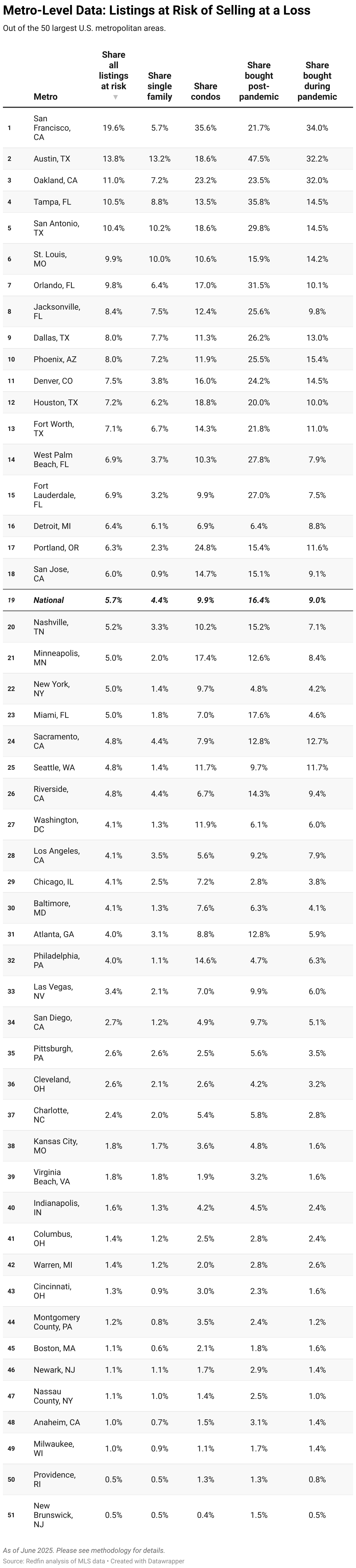
In Dallas, 8% of all listings are at risk of selling for less than homeowners bought them for. This is nearly triple the 2.8% share last year and one of the highest among the top 50 metros. Nationally, 6% of sellers are at risk of losing money on a sale.
However, the share varies widely depending on when someone bought their home, peaking for those who bought at the market’s height.
- 26% of sellers who bought post-pandemic are at risk of losing money on the sale, compared to 16% nationwide.
- 13% of sellers who bought during the pandemic are at risk of losing money on the sale. Nationally, this share is 9%.
- 0.4% of sellers who bought pre-pandemic are at risk of losing money on the sale, well below the 2% in danger across the country.
Although Dallas is a more balanced market than cities like Austin – which is seeing a sharp decline in demand – sellers still outnumber buyers, pushing prices down. In fact, Sun Belt metros generally have the largest shares of listings at risk of selling at a loss. This is because prices skyrocketed but then quickly came back to earth, leaving unlucky sellers in the lurch.
That’s not to say Dallas home sellers will actually sell at a loss. Typically, sellers facing a financial loss will wait until they find a buyer willing to pay the asking price, take their home off the market, or rent it out. Plus, the vast majority of sellers still make money on their home sale: Nationwide, 94% of homes sell for more than they were purchased for, compared to just 37% in 2012.
How has Dallas’ housing market changed since the pandemic?
The Dallas housing market was hot during the pandemic. Homebuyers rushed to take advantage of historically low mortgage rates, snapping up available homes and draining the city’s limited supply. As a result, prices soared: From 2020 to 2022, the median sale price climbed 43% to a record $463,000.
Now, three years later, the Dallas market has cooled significantly due to climate risks and insurance price hikes, with prices falling and homes taking 30 days longer to sell. This means that homeowners have lost some of the value they gained, putting them at risk of selling for less than they bought for.
Falling prices would create a larger gap
If prices fall in line with Redfin forecasts by the end of the year, more sellers would be susceptible to losing money on their home. Even the least-affected metros – New Brunswick, NJ, and Providence, RI – would see notable increases.
- If prices drop by the predicted 1%, 9% of Dallas listings would be at risk.
- If prices drop by 3%, 12% would be at risk.
- If prices drop 5%, 15% would be at risk.
Those who bought prior to the pandemic face the lowest risks of selling at a loss, but they’re also less likely to move in the first place thanks to their lower mortgage rates.
How buyers and sellers can navigate the Dallas market
Dallas’ housing market has shifted significantly since the pandemic, creating more opportunities for buyers and more pressure for sellers.
- Buyers: With elevated housing costs and more homes on the market, buyers still in the market are generally in command in Dallas. They should come prepared to negotiate and move quickly when the right home comes along.
- Sellers: Sellers generally don’t have the negotiating power they had during the pandemic, so they may need to offer incentives to attract buyers braving today’s market.
Complete metro-level data
Methodology
Based on a Redfin report, which analyzed active listings on the MLS in May for the 50 largest U.S. metros. All housing data is from Redfin. The report identifies the share of sellers at risk of selling at a loss, not the share of sellers who will actually sell their home at a loss, and does not take closing costs into account. We defined the pandemic as July 2020-July 2022, when home prices rose the most. Please see the original report’s methodology for complete details.